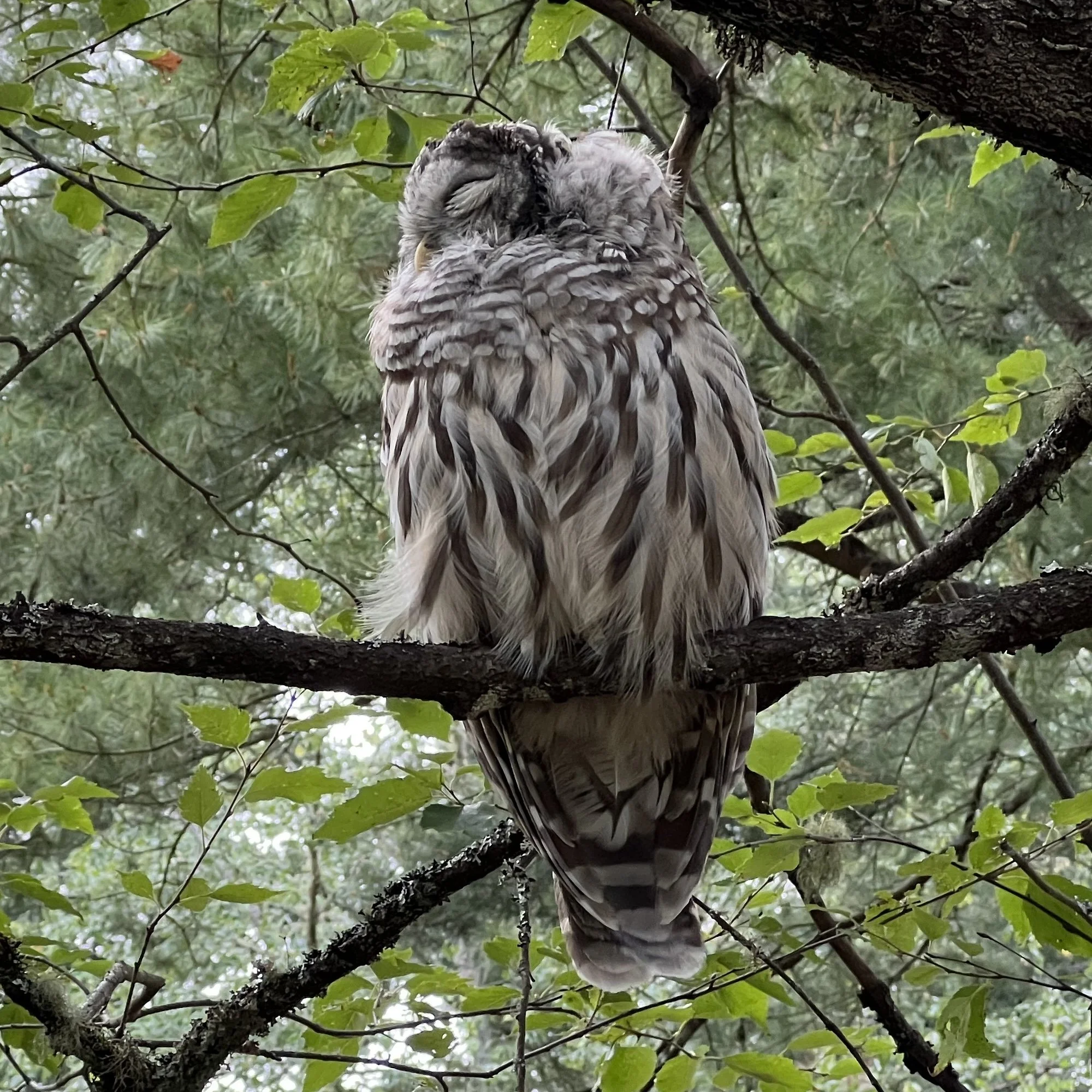
When I stop beneath Millie’s favorite tree, I feel like I’m still moving, my mind aswirl with worries of next week. Tilting my head back, I look into the splay of branches filling out with fresh oak leaves and squint at the sunlight streaming through the canopy. Once my eyes have adjusted, I scan the boughs for any that are unusual — one leaning heavily on another or, less likely but more telling, a branch that has an ear/thumb/ankle/any vaguely human-looking feature — but I keep spacing out. My thoughts are dominated by the refrain How am I going to manage while you’re away? With no one to give me a break from her and everything she can become, I’m guaranteed to be totally drained by the end of each day—or well before. She can make the most mundane of storytimes a rambunctious one-kid show with her starring as all the characters in a simple boardbook.
A breeze jostles the leaves above me and brushes cool air over my hands. When I put them in my coat pockets, my right hand pressing up against the little windbreaker that’s been balled up since she peeled it off and galloped away as a petite pony. My lips tighten at this reminder that I have to find Millie before she gets cold. So I scrutinize the branches as intently as I can. Still, I have to sweep my gaze around the tree’s crown three times before I’m satisfied that she isn’t here.
Eager to get to the playground, I stride across the field there’s no way for her to hide in. If there were dogs playing here with their owners, she might be a golden retriever or black Labrador sauntering about, waiting for me to figure out that she doesn’t belong to any of the dog owners, but no one’s here. And this familiar field feels especially empty without you and Millie running on the grass, switching roles of pursuer and pursued whenever one of you catches up to the other, all the while transforming — giraffe and wolf, then ostrich and pony, then jaguar and manticore — shrinking with distance. Once you’re thousands of miles away, she’ll have only me to chase and chase after her — a weak substitute for her favorite activity in the park.
Drawing closer to it, I scan the little playground abutting the field. Nothing seems out of place there either. No extra equipment, no additional trash can. Nothing that gets my attention, except a toddler at the top of the slide with his mother waiting below. I half expect him to become an armadillo or pangolin, to ball up and roll down the slide for his mother to catch. Of course, that’s not going to happen, but it’s become second nature to think about all kids the way I do Millie: always anticipating the next transformation.
Rarely is it the other way around. Millie only truly strikes me as an ordinary kid when she’s riding in the car, mesmerized by the scenery scrolling by outside the window. Otherwise, she seems ever-perched at the cusp of transforming. Even so, I hardly ever wish that her appearance would only change with a Halloween costume or age. The last time I felt that way was a couple of weeks ago, when she became a hedgehog and tore her new purple sweatshirt — then asked me to buy her another one. But the desire to have a more mundane Millie quickly evaporated. There was something endearing about her unwittingly destroying her clothing, some life lesson about the consequences of carelessness or about not appreciating what you already have until it’s gone.
Besides the mother and child, there’s only one other thing that’s not part of the playground: a stroller sitting by the empty swing set. That must belong to them. It’s too complicated a shape for Millie to make. So unless she’s lying on the ground trying to blend in with the wood chips that carpet this part of the park (which would be gross even to her four-year-old mind), she’s got to be somewhere else.
Bearing left, I head for the garden where she could be disguised as a rain barrel or bag of mulch or even a hose coiled up on a reel. The range of objects she can mimic has expanded tremendously in the last month, and you can’t stop telling me how impressed you are — how she’s surpassed your expectations for what’s possible at her age, thanks to her diligence during all those weekday evenings and weekend afternoons you spent channeling her excitement for becoming animals into the disciplined practice of turning her hand into a lobster claw or tiger paw, her skin into wrinkled linen and plaid flannel, the entire length of her spine-straight body with arms at her sides gradually then resolutely a marble column. She’s a fast learner when she’s motivated, and what could be more motivating than seeing you become a polar bear?
Before we know it, your pupil in the art of transformation won’t be limited to turning into things she’s seen. Like her teacher, she’ll be capable of becoming creatures and objects completely of her own imagining — albeit imperfectly at first, probably neglecting to change one of her eyes or feet as she often does with new forms. I don’t know what I’m going to do if she makes that leap in ability while you’re away. We’ve already hidden away the books with pictures of things we don’t want her turning into (which includes mermaids, because even though I’d love to see her as one, she’d want to swim in that form at the rec center pool or at least splash her tail in the tub for who knows how long and draw out bathtime even more). But no matter how vigilant we continue to be about what she sees in magazines and videos, the sky’s the limit for what she could dream up. Everything from sleek robots to chimeric monsters will soon be within her morphing grasp. Fortunately, the damage she could do will be limited. She’ll still have to concentrate to become whatever she’s imagined, and since she can’t focus on transforming when she’s upset, her tantrums will just make her a raging little human, the kind of monster every child can become.
In the garden, I find only plants. Tulips in full bloom and fruit trees leafing out. No new birdbath or compost heap. I’m about to head to the obstacle course when something catches my eye, my palms tingling before I can parse what I’m looking at. Then I see it: the last shrub in the hedge by the garden’s gate. Smaller than the others with not a single gap in its foliage to give even the tiniest glimpse of the street beyond it, this one has to be her. So I walk over and tickle this shrub, my fingertips agitating leaves that are too warm for any plant. With squeals of laughter, the little mass of foliage and twigs morphs into her, crouching and naked. And once again I’m thankful that hardly anyone comes to this park on weekdays.
Once the laughter has ebbed to leave her merely grinning, I take out her jacket from my coat pocket and get her to put it on. The weather is warm enough that she doesn’t feel cold, but she’s been losing body heat the whole time I’ve been looking for her. I get the jacket zipped up, and I’m about to tell her to make herself look like she’s wearing pants, but she changes into a monkey. And of course, the moment she’s done getting furry all over, she’s scampering off to her favorite tree, which can only mean it’ll be a while until we go home for lunch. That’s fine with me. I never get tired of seeing her up in those branches. And climbing on top of playing hide and seek means that she’ll nap soundly for a while this afternoon — a calm couple of hours when I can brew tea to sip at my leisure, when my sense of self can at last expand to fill the entire house, when I can check on her every half hour or so, maybe find her a panther cub or kangaroo joey or coyote curled up on the bed, maybe come up with ways to keep up with Millie’s exuberance — games to play, places to go, music to dance to — ways to stay sane while you’re away.